

One Idea. Two Movies
Love & Hate In Film Reference.

Two films from two very different time periods reflect on the universal battle between love and hate in this film reference. One idea. Two movies. One film reference. Love and hate are in our hands. Through the right hand of love and the left hand of hate, we shape our worlds. Both films studied in this film reference article, The Night of the Hunter and Do the Right Thing, explore the symbolic duality of human consciousness, from biblical texts to modern reinterpretations. In Genesis, Cain strikes Abel with his left hand. That same symbolic divide extends from the right hand of God to pop-culture images of angels on our right shoulders and devils on our left. Love and hate. Giving and taking. Yin and yang. Dark and light. It is one of storytelling and filmmaking’s most powerful themes.
This film reference study explores a connective thread of inspiration between two iconic cinematic interpretations of good and evil. Across two different eras, both monumental films comment on mankind’s ongoing Love/Hate battle.
This article was NOT written by AI. This was written by a living, breathing human being with a heartbeat and an undying passion for film.
The Story of Right Hand/Left Hand
In 1955, it was Charles Laughton, a first-time film director, who introduced his interpretation of Good vs. Evil to moviegoers with the story of Right Hand/Left Hand. His first and last movie (sadly), The Night of the Hunter, is one of the most admired films by some of the most celebrated film directors of our time.
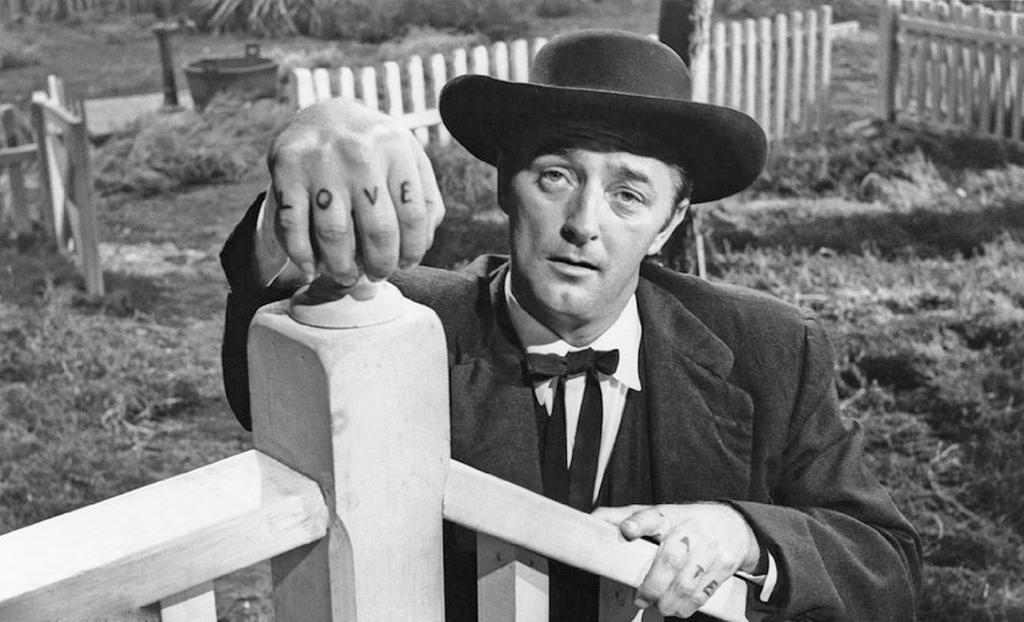
As the central antagonist of this film noir thriller, actor Robert Mitchum plays the devious Reverend Harry Powell. A wolf in sheep’s clothing. Hate is tattooed on the fingers of his left hand. Love is tattooed on the fingers of his right hand. The hymn-singing trespasser in religious garb passionately performs the fight of love and hate by wrestling his two hands against one another to illustrate the intense moral struggle of the film and, essentially, humanity.
Indirectly facing toward the camera, as if to address viewers rather than the characters of the film, the reverend illustrates his story. The story of Right Hand/Left Hand is a folktale that also proves to be the movie’s central theme and a foreshadowing device for what will come next in the story.
This monologue of good vs. evil is artfully directed by Laughton to serve as the chorus moment of the film. It is a device taken from Ancient Greek plays. Taking a page from the historic playwrights like Sophocles or Aeschylus, Laughton pauses the movie narrative to address the audience. In this brief moment, the chorus/monologue acts as commentary on the story’s exploration of mankind’s struggle with morality and what we see throughout the film: the immeasurable lengths people go to take what they want or protect what they love.
“H-A-T-E! It was with this left hand that old brother Cain struck the blow that laid his brother low. L-O-V-E! … The right hand, friends, the hand of love!”
Spike Lee Remixes Right Hand/Left Hand
Thirty-four years later, film legend Spike Lee reintroduces the cosmic battle of Right Hand/Left Hand with Do the Right Thing in 1989. The Brooklyn native director draws direct inspiration from Charles Laughton’s 1955 film noir chorus/monologue. In this controversial yet culturally iconic New York film, Spike modernizes and emboldens the Love/Hate hand motif. He ingeniously adds a fresh twist of in-your-face Brooklyn flavor to the Ancient Greek chorus narrative device.

This time, Spike Lee reimagines the words Love/Hate onto a set of glimmering brass-knuckle finger rings. The fight now launches directly at us through two gigantic punching fists of Radio Raheem. His godlike fists of fury and bronzed statements of Love/Hate punch at the camera to the pulsating rebel beats of Public Enemy’s “Fight the Power.” Radio Raheem’s quaking boombox projects a chaotic battleground rhythm that perfectly complements the never-ending conflict between the two opposing forces. The power is hate. And we must fight it every day, with love.
Radio Raheem is an oversized behemoth. A presence of cosmic energy, he interrupts the movie to commentate and orate the story’s central theme. Like the preacher in The Night of the Hunter, Radio Raheem captivates the audience with the timeless blow-for-blow battle between Love and Hate. His furious fist dance in battle to channel every war, every fight, every attack, and every retreat.
“These five fingers go straight to the soul of man.”
In Do the Right Thing, a community clashes in tension between Italian American and Black neighborhood locals. The community is in a constant struggle between loving each other and hating one another during one tense, sizzling summer in Brooklyn. As Laughton did before him, Spike Lee finds a new way to comment on the movie’s central theme and the daily Love/Hate battle of humanity that we face every day in our own lives.
Reference the Technique, Then Make It New
It’s not stealing or biting someone’s style if you find a way to make what inspires you new. Film reference is all about studying what’s been done in the past to find inspiration to create something new for the future. It’s a creative technique used by all sorts of artists throughout history, from Da Vinci to Warhol. Case in point: Although Spike Lee draws directly from Charles Laughton’s monologue hand motif, Spike finds a way to modernize and refresh it for a modern audience by infusing his own personal experience.
- The monologue now takes place in the middle of an urban street in Brooklyn instead of a house in depression-era West Virginia.
- The chorus orator goes from a reverend con-man to a boombox-toting giant.
- Love/Hate evolves from finger tattoos to brass knuckles.
- Instead of the Right Hand/Left Hand wrestling, they are now in a furious boxing match.
- The orator now speaks directly to the camera to reinforce the Ancient Greek chorus technique even further.
- The story of Right Hand/Left Hand has musical reinforcement by Public Enemy’s “Fight the Power.”
As you can see, Charles Laughton drew inspiration from the chorus technique from Ancient Greek playwrights like Aeschylus and Sophocles, and Spike Lee drew from Laughton to give us Radio Raheem’s chorus. And, if history teaches us anything, this cycle of inspiration and reference will continue to bring us another clever, fresh reinvention of the chorus/monologue to drive audiences into deep reflection of the human soul.
How do you see this visual concept coming to life in the next modern cinematic embodiment? Any ideas on how you would do it? Have you seen newer takes on the Love/Hate Right Hand/Left Hand concept?
Film reference often goes hand in hand with visual research.
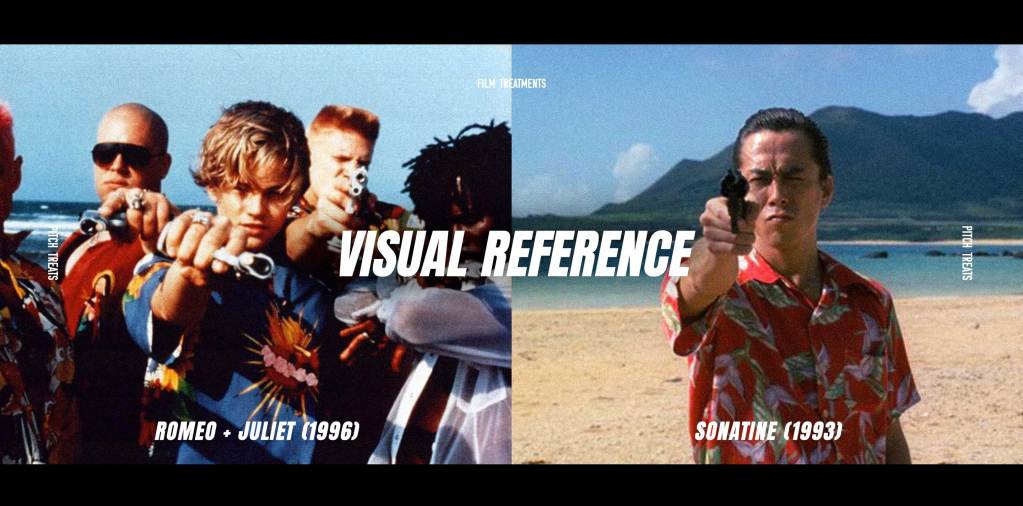
Both studies explore specific aspects of a film or visual technique in order to concept and visualize a new idea into production. Pitch Treats combines visual research and film reference with pitch deck design, story outlines, loglines, and narrative structure to create cohesive, studio-ready film pitch decks.
Whether you have a feature film, a TV series, a documentary, or a music video, Pitch Treats will help you pitch your story into production.
Thanks for reading. I hope you enjoyed this article and I hope you found something useful that you can use for your projects.
Until next time.
Yours truly,
Pitch Treats
Subscribe to Pitch Treats for more articles on filmmaking inspiration, movie pitch decks, director treatments, visual research, and TV show bibles.


